Category: Economics

Monday Links

I wanted to blog about the PayPal kerfuffle last week, but we’ll, I’m out of pocket. So, I’ll post a Reason article about it. When Eugene Volokh is concerned, I sit up and take notice. I don’t keep money with PayPal, and it looks like I’m going to be winding down my use of it for other things.

The New York Post ran a scare article on how all of these virtual jobs will be outsourced. I’m more skeptical, mostly because I think the labor market is undergoing a massive transformation.

Reason has a good overview of the ESG movement in the corporate world. Stakeholder is one of those concepts that have been twisted into a club against the business community. Worse, they seem to be wielding it against themselves to impress people who hate them regardless.

The Verge has an article on Microsoft abandoning the Office brand. It’s transitioning to Microsoft 365. Eh, I’ll still probably refer to the core apps as “Office”.

For a couple of light items to round out this week’s links:

Gizmodo talks about a new gaming chair from Logitech and Herman Miller. Personally, I’m more amused by the collaboration than the actual product.

Finally, The Wife found this listing for a cat advent calendar. Not treats for your cats, but a bunch of tiny cat figures.


Monday Links

First, from US News & World Reports an article on how detrimental the school closures were for the kids. New federal data – the first comparing academic achievement from before the coronavirus pandemic to now – shows unprecedented drops in math and reading scores and the largest setbacks for students in more than half a century. Way back in March/April of 2020, there might have been a case for closing the schools. We didn’t know enough about how COVID was spread, how dangerous it was, and who it impacted the most. However, as we learned more, it was clear that the biggest obstacle to opening the schools were the unions who wanted their members paid for not having to go into the schools. I think we will be feeling the ramifications of this for a very long time.

It’s not Derek’s links without Reason articles. So here’s one on what happened when Sri Lanka banned synthetic fertilizers. The short version? Famine, inflation, government destabilization. Everything a country needs. <Sarcasm>

And here’s another on embracing the prepper mindset. Seriously, hasn’t the last two years kind of proven it’s probably a good idea to have some extra supplies on hand? As reader David says in his articles at Blue Collar Prepping, “Some is better than none.”

From The Reload, comes an article on a recent survey of gun owners. According to the article, this was the largest survey done with more in-depth questions. So, what did it find? Gun owners are more diverse, they are carrying more, and they often own the same weapons and magazines that many want banned. Oh, and they are possibly more than 1.5 million defensive gun uses annually.

What We Pay

I was listening to The Michael Shermer Show where he was interviewing Marian Tupy and Gale Pooley on their new book Superabundance.

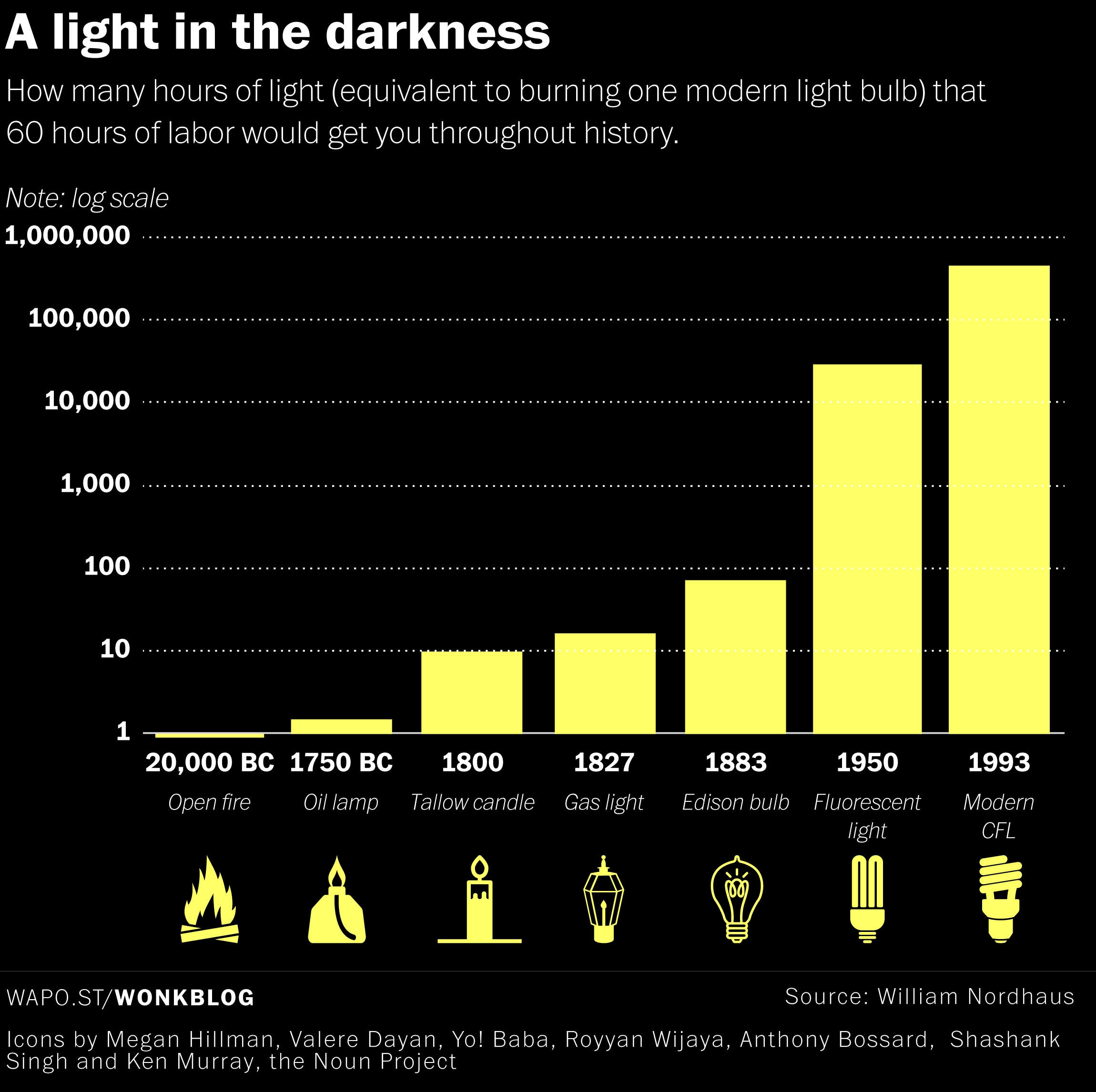
A statement made by one of the authors hit me. We buy things with money, but we pay for them with time. They went on to discuss how economics made a mistake by measuring prices in terms of monetary cost instead of measuring the cost of goods/services in work-hours.

One of the dramatic examples is how much in terms of time we have to pay for an hour of light.

From the Washington Post article. And with modern LEDs, the efficiency is even better.

Monday Links

First, a couple of links regarding the housing issue.

From CBS comes an article that a school district near San Francisco is trying to keep teachers by offering low-cost housing on school district property. This has been an issue facing the area I live in. The editor of one of the local papers calls it a shortage of "workforce housing." How do you house all the people between the lower class and the upper middle class who do all of the work needed to run our cities and our businesses? Some good solutions (like what this school district is trying) are needed before the failing ones (like rent control) are brought back out.

One of the downstream impacts of the housing market has been an increased demand in storage units. A recent report from Yardimatrix expects demand to continue to be high and sustained Considering how many self-storage places are going up near us, this doesn’t surprise me.

A couple of new gun offerings that interest me.

First, TFB has an article on B&T’s folding sub machine gun. I have been fascinated by folding subguns since Robocop 2 and B&T has just been putting out neat stuff. I’m really looking at their APC308 for my heavy AR slot.

From GH Hill, comes Big Horn’s new 500 S&W tactical lever action. One of my Zombie Strike characters carried one of their levers, and there was some temptation to give Nick one in Badmoon.

Finally, an article from Nature on why we get tired when we think really hard. From the article: "The study, published on 11 August in Current Biology1, found that participants who spent more than six hours working on a tedious and mentally taxing assignment had higher levels of glutamate — an important signalling molecule in the brain. Too much glutamate can disrupt brain function, and a rest period could allow the brain to restore proper regulation of the molecule, the authors note. At the end of their work day, these study participants were also more likely than those who had performed easier tasks to opt for short-term, easily won financial rewards of lesser value than larger rewards that come after a longer wait or involve more effort.”

Monday Link Time

First, just in time to celebrate the feds for passing their crony corporatism for the semiconductor sector, comes this article from Bloomberg about a coming bust in that sector. The semiconductor market enjoyed a massive run-up in orders during the pandemic, sending sales and stock prices to new highs and triggering a global scramble to find enough supplies. There was hope in some circles that the boom could be sustained for several more years without a painful pullback, but chipmakers are now facing a familiar problem: growing inventory and shrinking demand. [Snip] But fortunes have turned swiftly for the biggest chipmakers. Companies like Nvidia Corp. are reporting more that 40% annual declines in their core businesses, while Micron Technology Inc. warns that demand is evaporating fast in many areas. Well, this feels familiar. Particularly those of us who have watched the boom and bust cycles in the firearms industry.

The joke was that the lamentations of enlisted soldiers who couldn’t poorly spend their enlistment bonuses or sign up for bad loans on Dodge Chargers and Challengers, because the automaker is discontinuing them. Dodge will be putting an end to its iconic Charger and Challenger lineup real soon as the company teases a new era of mystery cars to come. The electrified future is slowly creeping into Dodge’s ICE-ladened inventory. It sounds like the lamentations will be short-lived as the young men will have electric versions to make bad decisions about.

At least, it will be cheaper in the future to hear better as the FDA approves OTC hearing aids. Come October, instead of being forced to visit an audiologist and shelling out thousands of dollars for the added expense, hearing aid users will be able to purchase FDA-certified hearing aids from any major retailer like AmazonWalmart or Best Buy without needing a prescription. IMO, we will see some good, generic hearing aids, but the best will still require special testing and fitting. Kind of like electronic ear pro we have now.

In the life-saving category, we have an article from Active Response Training on the best tourniquets. You really need to RTWT. And take a Stop The Bleed course. And don’t cheap out on your tourniquets.

Finally, our light item (courtesy of The Brother) is on the proper method of peeling off Post-It Notes. The article is amusing, but the TLDR is peel side to side, not down to up.

Friday Quote – Peter G. Klein

Under interventionism companies must employ large staffs of lawyers, accountants, lobbyists, public relations teams, and others who focus not on creating economic value, but on satisfying legal, tax, regulatory, and other government requirements.

That large firms are filled with such non-productive employees is not, Mises writes in *Human Action*, “a phenomenon of the unhampered market economy”, bit a result of government policy.

More Links? Weird Week

I’m doing another link post mostly because of the first article (i.e., didn’t want to wait until next week to post.)

So, Sweden and Finland are moving ahead with plans to join NATO. There are many countries in NATO that I think was foolish to add. These two? I’d be happy if they were in the club, as it were. Haake Palle!

Since the housing market is still red-hot around here, I’m getting vibes of 2008. According to this Forbes article, this market may not be a bubble. While I will conceded some of the points, I’m still a little concerned. I’m willing to believe that the supply issue will keep the market going for quite a while. My contention is that while there may not be a lot of lending fraud going on – compared to 2007 – I’m more leery of lending ineptitude. Considering how rushed and slap-dashed the mortgage on Ward Manor was done, I can see that playing out over the industry.

Random Thoughts

I was listening to Econtalk where Michael Eisenberg was the guest. He’s an Israeli venture capitalist. One of the techniques he discussed was “backcasting”. Essentially, he looks at a technology, determines the endpoint, and then works backward to determine the feasibility of the steps needed to get to the endpoint. He was using the example of driverless cars to show how the underlying technology needed to get to fully autonomous cars was still not there to expect a truly fully autonomous car in the near future. I thought it was neat, because I use a similar technique in writing. So, I may come up with a scene or an idea. Okay, what do I need to get to there?

Speaking of podcasts, on an episode of Words & Numbers, the hosts were musing about the downfall of Amazon. The harbinger of this was the degrading of the level of customer service. The hosts were musing that brands that fell in the past were often preceded by a degrading of the little things – cleanliness of the stores, friendliness of the employees, etc. It’s an interesting point, and I’ll have to bear in mind as I watch Amazon in the future.

And for something completely different, I’m kinda excited about Mossberg’s new auto shotgun. It looks like what I’ve been wanting in terms of styling and it looks like it may price under $1K. I’ll wait to see what some of the reviewers say, as well as seeing how one feels in my hands, but this may be a contender.