You need to RTWT, but the biggest takeaway from this article is that fracking is like most industrial processes. If done properly, there is minimal impact. Done improperly, and it causes harm to others.
So who sets the standards? I’m more inclined for industry to set standards because they are going to be more knowledgable and have more to lose. Others may think that a government agency or agencies should set the standard. Considering what those agencies have done to accounting and pharmaceutical development (through the SEC and the FDA), I’m not as certain.
Science, by its nature, helps humanity push back the veil of ignorance to see how our universe works. Science is also self-correcting. Sometimes, the picture we see is wrong because only part of the veil has been pushed back. As we push further, the more complete picture we can see.
Please view this before continuing on with the post. It’s only about 90 seconds of your time.
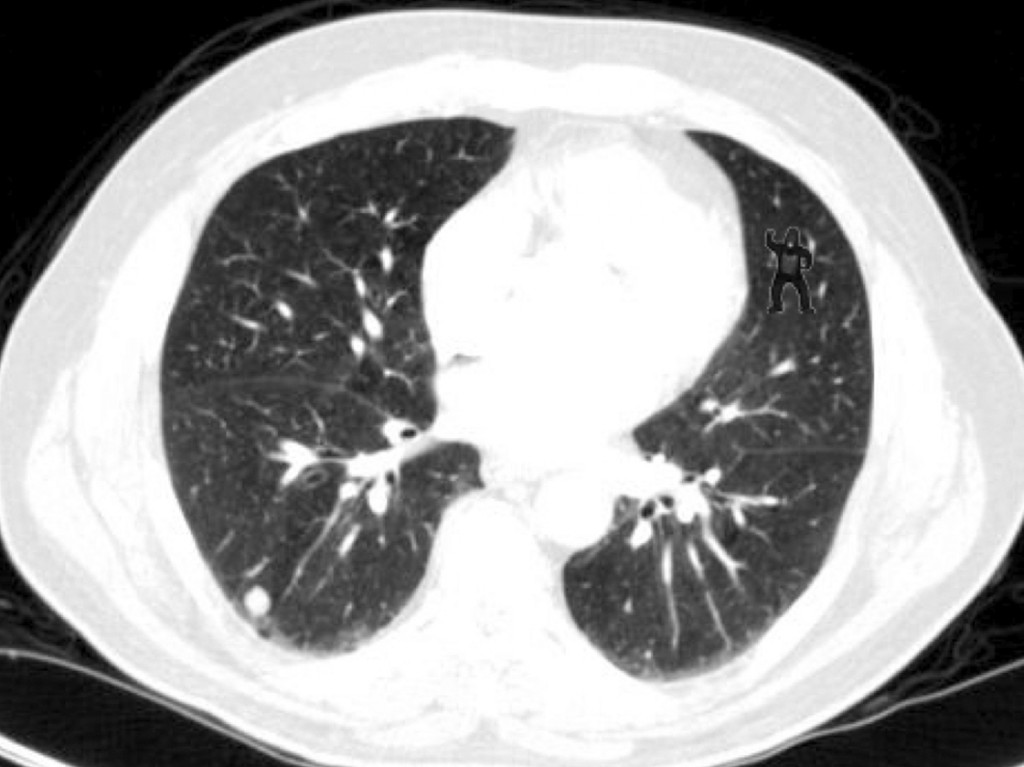
I’ll be the first to admit that I didn’t see it the first time through either. Then I was listening to the Skeptics Guide to the Universe podcast as they discussed this news item about radiologists so focused on finding the expected anomalies, that they completely missed the gorilla in the pic. Click to make big
I’m sure your thinking This is all very interesting, but what does it have to do with me in my life? During the discussion of the radiology experiment, Steve Novella mentioned an experiment in 1959 where a researcher dressed up as a ghost and walked across the stage during the previews of a movie. According to the story, only about half of the people even noticed it. This phenomena is called selective attention, and it has real implications for maintaining situational awareness.
Let’s think back to the Aurora theater shooting. After looking at the video and the article, ask yourself this. Would you have noticed the guy in a costume until he opened fire? Here’s the damning part about the radiology experiment. We in the self-defense community think we’ve been trained to notice such anomalies, but so did the radiologists. Instead, they only focused on what they were supposed to be looking for. For myself, I don’t think I would have noticed until the gunfire. I realize this is a possible weakness, and I will try to remedy it in the future by being more observant. This is also where planning for contingencies comes in handy. If this happens, I’m going to do this… Why? Because you’re shortening your reaction time. Selective attention means a shorter window to implement any reaction to the threat. Contingency planning means when the threat occurs, all you’re doing is implementing.
Be watchful for the gorillas out there. Some of them are dangerous.
Those were some amazing shots of the meteor as it came down in the Urals. RT.com has a running update of the news surrounding the meteor impact.
This rock from space caused 500 injuries (at the time I’m writing this), lots of damages, and a six-meter crater on impact. As bad as we are to ourselves through war, famine, and damage to the environment/climate, we will always be pipsqueaks compared to the dangers from the planet itself and the cosmos. I’m not saying we shouldn’t try and solve our own issues, but the sheer power of the natural forces absolutely astounds me.
Six Italian scientists were convicted of manslaughter because they followed the evidence and didn’t predict a massive earthquake that killed 300 people in 2009. In Italy. Not some third-world backwater of a place, but what is supposed to be a modern, industrialized nation. In response to the convictions, most of the senior members of the Civil Protection Commission, including its leader, have resigned. If this could happen in Italy, where else could such trials occur? France, Germany, Britain, the United States?
Why did this happen? In my opinion a fundamental misunderstanding of the basic principles of science led to the easy scapegoating of these scientists when the public needed someone to blame in their grief. “Those damn scientists told us nothing was happening and then an earthquake killed 300.” Here’s the dirty, little secret of science. It can only make predictions based on the current knowledge of how the physical world works, and that knowledge is incomplete. Sometimes that leads to incorrect hypotheses. In this case, the scientists looked all at the evidence made a prediction and the physical world did something else. It would be no different if a doctor looked at a patient’s symptoms and test results and treated appropriately, but the patient died because of something unknown or unpredicted. We don’t blame the doctor because of the limitations of modern medicine.
I am encouraged by the public backlash to these convictions, but I can easily see the same thing happening elsewhere. The only way to combat this is to help educate our fellow citizens on how science works and what it can or can’t do.